UAD 3.6 is changing the appraisal. Here's what real estate agents need to know
By Lara Locke | Sources reviewed September 29, 2026
If you've been in real estate for a while, you probably have a pretty good picture of what happens when the appraiser shows up.
They walk the property, take photos, measure the home, make notes and deliver a report that most of us recognize.
The reporting is changing.
Fannie Mae and Freddie Mac are moving to the Uniform Appraisal Dataset, or UAD 3.6, and a redesigned Uniform Residential Appraisal Report. The report is built to adapt to the property and appraisal assignment rather than rely on the familiar set of separate forms. Redesign overview
Broad production began earlier this year. Starting November 2, 2026, new appraisal submissions to the Uniform Collateral Data Portal, the system lenders use to send appraisal data to Fannie Mae and Freddie Mac, must use UAD 3.6. Some revisions to reports submitted before the deadline can continue in the older format during the transition. This is a submission deadline, not simply the date the appraiser visits the home. Official transition timeline
For agents, the useful question is what to prepare before the appointment.
Prepare sellers for property documentation
For a traditional appraisal with an interior visit, explain that the appraiser needs access to the spaces relevant to the assignment.
Fannie Mae's UAD 3.6 policy calls for interior photos documenting kitchens, bathrooms, living spaces including bedrooms, finished and unfinished below-grade rooms, visible defects and examples of recent updates. Photo requirements, SB4-1.2-01
View photo examples: kitchen, bedroom and unfinished lower level.
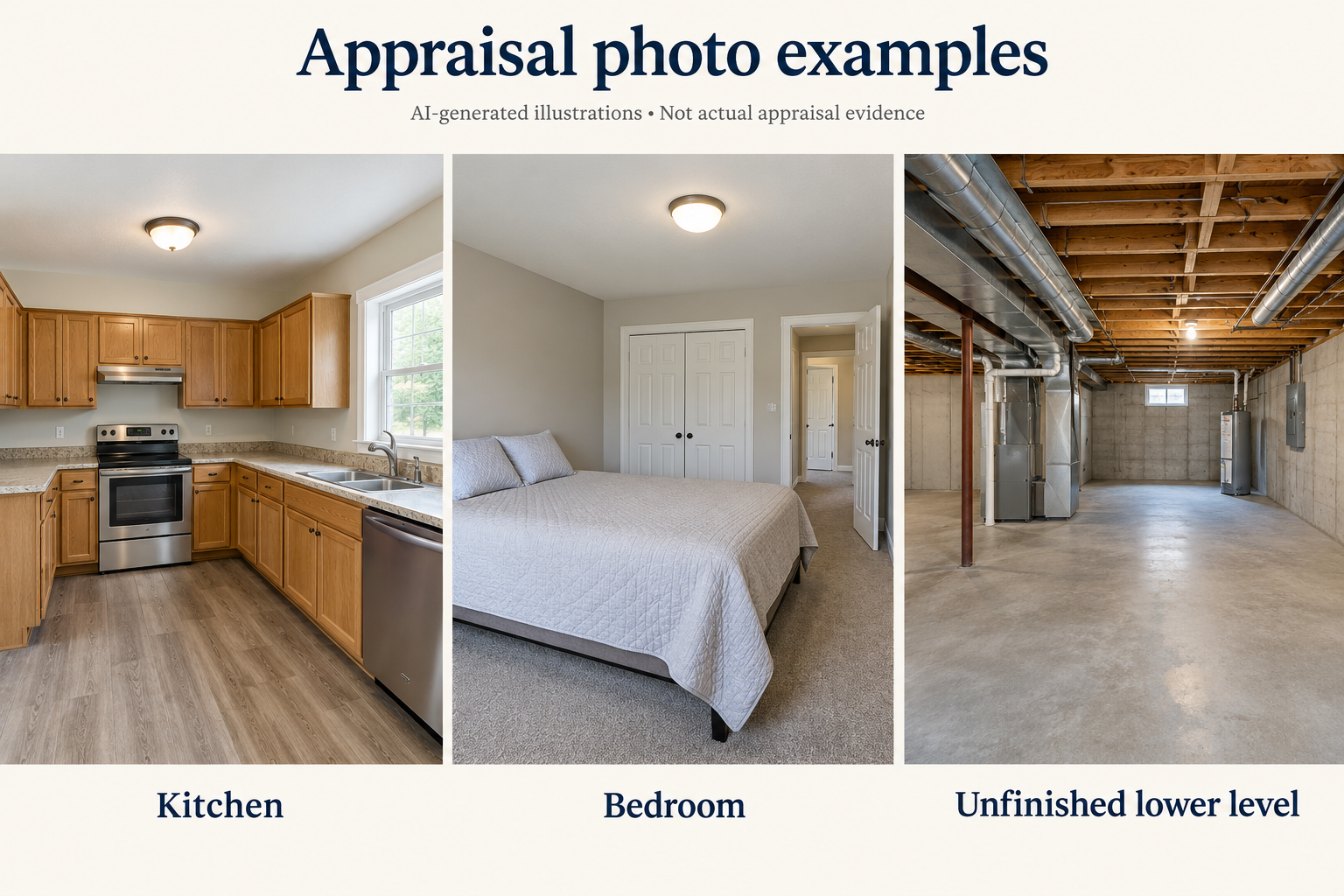
AI-generated illustrations, not actual appraisal photographs or official Fannie Mae examples. These three spaces are not the complete required photo set.
A seller who expects photos of just the kitchen and living room may be surprised. Have the access conversation beforehand.
Ask sellers to make rooms and additional structures accessible and to discuss any access concern with you before the visit. A closed bedroom, locked accessory dwelling unit or space blocked by stored belongings can make documentation harder.
This is still an appraisal. The appraiser is developing an opinion of value. A separate home inspection serves a different purpose.
The new report does not mean every appointment will take a set amount of extra time. Ask what the assigned appraiser needs rather than promising a specific inspection length.
Give the appraiser clear, accurate property information
Have a concise summary of meaningful improvements and unusual features ready.
Include the source of any square-footage figure, available permit information, renovations, additions, solar details and accessory dwelling units, often called ADUs. Explain what you know and identify anything that still needs verification.
If records and the property do not line up, flag the difference. Do not assume an addition is permitted or that an ADU is included in the main home's reported area.
The appraiser still decides how to analyze the information. Provide accurate facts through the lender's accepted process without asking for a predetermined value.
Understand that the report fits the assignment
A redesigned report can describe different property and appraisal types. It does not mean every assignment includes the same visit or documentation process.
Some appraisals rely on a property's data collected by another person. Others use third-party information without the appraiser visiting the home. The loan's permitted appraisal option determines the process.
Floor-plan and sketch requirements also vary. Under Fannie Mae's UAD 3.6 guidance, a floor plan is required for desktop and hybrid appraisals and for certain traditional appraisals involving unusual layouts. A footprint sketch can be used for a qualifying traditional appraisal. Exhibit requirements, SB4-1.2-01
Confirm the assignment before telling a seller what to expect.
Know where your listing's square footage came from
Square-footage discrepancies already happen. A listing, county record, seller estimate and appraisal may measure or group areas differently.
UAD 3.6 gives the appraiser a more structured way to report those areas. It does not introduce every measurement rule for the first time.
For an agent, the first step is straightforward: know the source of the listing figure and what it includes. A finished lower level or separate structure needs its own explanation. Fannie Mae measurement guidance
We'll go into that in the companion article, Why listing square footage and appraisal square footage can differ.
More detail does not tell us what the value will be
A more detailed report does not, by itself, tell us whether an appraisal will be higher or lower.
The appraiser still studies the property and market and develops an independent opinion of value. The report's redesign and a particular property's value are separate questions.
I would focus on preparation: clear access, accurate records and a useful explanation of the property's features.
What I would start doing now
Confirm the appraisal type and ask what access is needed.
Prepare the seller for the relevant photography.
Know the source of your listing's square footage.
Have a short improvement list and supporting information ready.
Identify additions, ADUs, separate structures and record discrepancies early.
If something about the property is difficult to explain, bring it up before the appointment.
Have a listing with an ADU, an addition or conflicting square-footage figures? Discuss the scenario with me so we can get clear on the financing questions and what needs to be verified.
Sources
Fannie Mae and Freddie Mac: UAD 3.6 transition timeline. New-submission deadline and provisions for previously submitted reports.
Freddie Mac: UAD and forms redesign FAQs. Report redesign and rollout.
Fannie Mae: UAD 3.6 Selling Guide supplement, September 2026. Sections SB4-1.2-01 (photos and exhibits), SB4-1.2-02 (desktop), SB4-1.2-03 (hybrid), and SB4-1.3-05 (reported area).
Fannie Mae: Standardized property measuring guidelines. Measurement background; use the applicable current appraisal policy for the assignment.
Lara Locke NMLS 949406 | CrossCountry Mortgage NMLS 3029